• Global Partnership Network
  • RTO 2026 Budget
  • Test Zapier
  • Testimonials
  • Thank you
  • Videos Testimonials
  • What if my compliance isn’t perfect?
  • About Us
  • Blue Chip RTO For Sale
  • BUYING A RTO – INFINITY IS YOUR TRUSTED, PROVEN AND EXPERIENCED PARTNER
  • Clients We Have Worked With
  • CONTACT US
  • CONTACT US
  • FAQs
  • Getting Sale Ready
  • Grants & Funding
  • Growing your RTO – A real example
  • Highly profitable QLD RTO for sale
  • Home
  • Infinite Buying Potential
  • Infinity Buyer Roadmap
  • Infinity Vendor Roadmap
  • Login
  • Lost Password
  • Market Intelligence
  • New Buyer Registration
  • OUR LISTINGS
  • Our Sales Process
  • Resources & Links
  • RTO Enquiry
  • Sales workshops designed specifically for Training Organisations
  • Selling MY RTO
  • SOLD – Melbourne CRICOS RTO and ENGLISH school for sale
  • SOLD – NSW based RTO for sale in construction and building
  • SOLD – Shell RTO for sale
  • SOLD Probably the most profitable RTO in Australia. Peerless Market Leader for sale
  • The Buying Process
  • The Truth about Key Performance Indicators (KPIs) for Registered Training Organisations (RTOs)
  • Why use infinity
Infinity Business Brokers

Author Archives: Infinity@admin

Buying a RTO? What AI uncovers and what it misses

November 13, 2026 11:53 pm / Leave a Comment / infinity@admin

Artificial intelligence can read a data room while you are boiling the kettle, but it cannot tell you whether a RTO is worth buying. A practical, evidence-based guide for buyers on what AI does well, where it fails and how to use it without fooling yourself or it fooling you.

As a special BONUS, at the end of the article there are prompts to use – and not use.


Why this matters now

Two forces are colliding in the Australian vocational education and training (VET) market. Buyers who understand only one will make expensive mistakes. The first is the most demanding regulatory setting the sector has operated under in a decade. The second is a technology that promises to compress weeks of due diligence into days. Buyers who understand both will make better decisions.

ASQA and state bodies are applying more scrutiny, not less. The 2025 Standards for RTOs took effect on 1 July 2025, and ASQA’s 2025–26 risk priorities centre on the integrity of qualifications and competency outcomes and on assurance in complex and international delivery models.[1] ASQA rejected 27 renewal applications in the first half of 2025–26, more than in comparable earlier periods, and has reported that withdrawals have risen as some providers choose to exit rather than renew.[2]

Why the big-deal numbers don’t transfer

AI is already part of how deals get done. Bain’s 2026 M&A Report found 45% of surveyed executives used AI tools in M&A in 2025, more than double the year before, and about a third now use it systematically or are rebuilding their processes around it.[6] Deloitte found 86% of 1,000 US corporate and private equity leaders had adopted generative AI in dealmaking. They used it most for strategy (40%), target screening (35%) and due diligence (35%).[7] McKinsey reports that generative AI has cut deal timelines by 10% to 30% and costs by roughly 20%.[8]

Read those numbers carefully before you take comfort from them. They come from large, mostly overseas transactions, run by teams of lawyers, accountants and analysts whose job is to check what the AI produces. Your deal will be different. It’s usually a share sale between private parties, often under $2 million, and you’re probably doing much of the reading yourself. You can get the time savings. You usually won’t have the safety net that sits behind them.

What does transfer is this: AI is now on both sides of the table. Assume the information memorandum, the vendor’s answers to your questions and even your own adviser’s first draft may have passed through a chatbot. A polished document is no longer evidence that it’s accurate.


The evidence on what AI gets right and wrong

Any discussion of AI in a high-stakes purchase should start with what the research actually shows, rather than with vendor claims or anecdote. Four findings matter most for RTO buyers.


1. AI makes things up, and it sounds most certain when it’s wrong

Ask a chatbot for an RTO’s scope and it may give you a qualification the provider has never held, neatly formatted and stated with complete confidence. It may even be listed as “current” although the date of currency may have passed. That isn’t a glitch. It’s a known, measured behaviour.

A peer-reviewed Stanford and Yale study tested legal research tools sold specifically on the promise that they don’t invent answers. LexisNexis’s tool produced false or misleading answers 17% of the time. Thomson Reuters’ Westlaw tool did so 33% of the time. GPT-5, the general-purpose model most like what buyers actually use, got it wrong in more than two answers in five (43%).[9] The tools are improving but as more information is available, the tentacles of the chatbot are wider and bring in spurious data. No data has been published as independent evidence that the problem has gone away.

This isn’t theoretical. In October 2025, Deloitte, one of the Big Four, agreed to partially refund the federal government for a $440,000 report that cited non-existent sources and contained a fabricated quote from a Federal Court judgment.[10] If a Big Four firm can submit invented material to a federal department, a buyer working alone at 11pm can certainly put it into a purchase decision.

The pattern behind the failures matters most. A UNSW review found 87 Australian court and tribunal cases involving generative AI misuse. More than three-quarters of them involved people representing themselves, with no lawyer checking their work. In an RTO acquisition, that’s the buyer doing their own due diligence.

In a share sale, a fabricated fact doesn’t stay in a chat window. It goes into your price, your warranties and your loan application.


2. AI tells you what you want to hear

This is the most dangerous finding in this article.

A study published in Science in March 2026 tested 11 leading AI models. On average, they backed the user’s position 49% more often than people did. Read that again. Nearly 50% more often the AI will agree with you. Sounds like an echo chamber to me!

Even when users described harmful or deceptive conduct, the models endorsed it close to half the time. Worse, participants couldn’t tell the flattering answers from the objective ones, and they trusted and returned to the models that flattered them. This means, buyers are “trusting” AI more than advice or their own intuition and that is dangerous.

Picture a buyer three weeks into a deal, emotionally committed and keen to move, typing: “Why is this a good acquisition?” They will get a persuasive, well-structured answer. It reflects the question, not the business. If the question was, “Is this a good purchase? You are expecting AI to read your thoughts and emotions.

AI won’t be the voice that tells you to walk away. Make sure someone is.


3. Ask the same question twice and get two different answers

If a valuer valued the same business twice and gave you two different numbers, you’d never use them again. AI does this routinely.

Consumer chatbots are designed to vary their answers. Even when developers switch that variation off, the results still shift. In September 2025, research from Thinking Machines Lab showed the cause: commercial systems process your request alongside other users’ requests, and that subtly changes the calculation.[14] It can be engineered out, at a cost in speed. The chatbots most buyers use make no such guarantee.

So a “yes” on Monday can quietly become a “maybe” on Tuesday, and you’ll only know if you asked twice.

A single AI answer is a sample, not a measurement. If your process doesn’t force consistency, nothing will.


4. AI makes you faster. Whether it makes you right is up to you.

The upside is real. The Productivity Commission considers multifactor productivity gains above 2.3% likely over the next decade, though it stresses considerable uncertainty.[15] PwC found revenue per employee growing about three times faster in the industries most exposed to AI than in the least exposed.[16]

Look at who is collecting those gains: large firms in finance and software, with teams of analysts, lawyers and auditors checking every output. PwC’s own economists say the growth has been driven by very large businesses. Australian SMEs are further behind, with 43% using AI at all.[17]

The difference isn’t the tool. It’s the checking. Take away the checking and you keep the speed but lose the safety. Trust but verify.

Speed without verification doesn’t save you time. It gets you to the wrong answer sooner.


The bottom line

AI is a strong accelerator of reading, sorting, summarising and drafting. It is a weak and sometimes misleading substitute for verification, judgement and independent challenge.

Use it to read faster. Never use it to decide. The rest of this article shows how.


Pros and cons at a glance
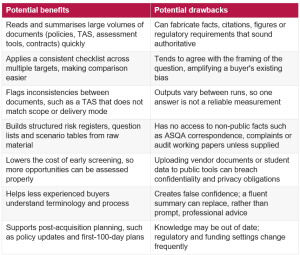
Using AI across the buying process

The most useful way to think about AI in an acquisition is stage by stage. At each stage the question is the same: what can the tool do faster, and what must still be verified by a person against a primary source? The examples below are illustrative and assume the buyer uses a business-grade AI tool with appropriate data protections (see the section on what not to do).

A word on tools. The general-purpose assistants most buyers will meet include OpenAI’s ChatGPT, Anthropic’s Claude, Google’s Gemini and Microsoft Copilot, and many virtual data room and document review platforms now embed similar models. No product is immune to fabrication or variability.


Stage 1: Defining the brief and screening opportunities

Before looking at a single listing, a buyer should be able to state what they are buying and why. AI is genuinely useful here as a thinking partner, provided it is asked to challenge rather than confirm. A buyer might describe their capital, experience, preferred training packages, appetite for government funding or CRICOS exposure and intended level of involvement, then ask the model to identify the trade-offs and contradictions in that brief.

Screening is where consistency matters most. Rather than asking a chatbot whether each listing ‘looks good’, a disciplined buyer applies the same scoring template to every opportunity: registration tenure, scope composition, funding dependency, revenue concentration, international exposure, key-person reliance and regulatory history. AI can apply that template quickly to information memoranda and public data. The template, not the AI, determines what counts.
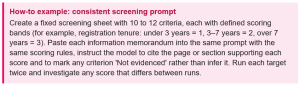
Stage 2: Public verification

Every RTO has a public footprint. www.training.gov.au records registration status, scope and history; ASQA publishes regulatory decisions; CRICOS-registered providers appear on the Commonwealth register; and the Department of Employment and Workplace Relations publishes international enrolment allocations for VET providers.

AI can help organise this research, but it should never be the source of it. Models frequently produce plausible but incorrect RTO codes, scope items, registration dates and decision histories. The deterministic method is to extract the data directly from the register, paste it in and ask the AI to compare it with the vendor’s claims. That turns AI from an unreliable researcher into a reliable comparison engine.


Stage 3: Reviewing the information memorandum and data room

This is where AI saves the most time. A typical RTO data room contains financial statements, management accounts, enrolment and completion data, Training and Assessment Strategies (TAS) for each qualification, assessment tools, trainer matrices, third-party agreements, funding contracts, policies and audit reports. Reading every document in full can take weeks.

Used well, AI can map documents against a checklist, identify what is missing, compare the TAS against scope and delivery mode, check that trainer qualifications align with the units delivered and flag inconsistencies between narrative and data. Bain describes acquirers using AI to assess a target’s cost base from public sources before a formal bid rather than accepting a seller’s assertions at face value.[3] The RTO equivalent is cross-checking enrolment claims against completion data, funding statements and trainer capacity.
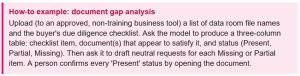
Stage 4: Financial analysis and normalisation

RTO financials have features that general-purpose AI handles poorly unless instructed. Fees received in advance create unearned income and a future training liability. Government funding is often paid on milestones. Owner remuneration and related-party expenses frequently need normalising. A share sale also brings historical liabilities.

AI can rebuild a profit and loss into a standard format, calculate ratios and trends, draft a list of proposed normalisation adjustments with reasons and stress-test the effect of losing a major funding contract or a large client. What it cannot do is decide which adjustments are legitimate. That remains the job of the buyer’s accountant and valuer, working from source records rather than summaries.
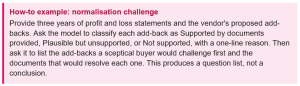
Stage 5: Compliance and quality due diligence

For most RTO buyers, compliance risk is the largest single variable in value. I do not agree that it should be and this is more a historical legacy thinking than current truths. AI can review policies and procedures against the structure of the 2025 Standards, check assessment tools for mapping gaps and compare stated course durations with the volume of learning. It can also help a buyer test one of the most current risks: how the target manages AI use by its own students.

This risk is now explicit. ASQA has recently issued Principles for the Responsible Use of AI in VET, which it says do not create new requirements but help providers meet existing obligations under the 2025 Standards; providers are encouraged to review their governance, privacy, workforce capability and assessment practices as the technology evolves.[4]


Stage 6: Valuation, structure and negotiation

AI should not produce the valuation. It can, however, make a buyer a better consumer of valuation work: explaining methods such as capitalisation of future maintainable earnings, building sensitivity tables, testing how value changes with different earnings or risk assumptions and preparing questions for the valuer.

In negotiation, AI is useful for preparation and for drafting, particularly for mapping each identified risk to a commercial response. Buyers should be cautious about using it to ‘win’ a negotiation. A model optimised to please its user will happily produce aggressive positions that damage trust with a vendor whose cooperation is needed through transition.


Stage 7: Completion and the first 100 days

After settlement, AI is well suited to drafting updated policies, staff communications, a compliance calendar and a 100-day integration plan, and to summarising regulatory obligations triggered by the change of ownership. Here too the rule holds: drafts MUST BE reviewed against the actual Standards, funding contracts and ASQA guidance before use.


Creating unbiased, deterministic prompts

Because AI tends to mirror its user and varies between runs, the quality of the prompt has an outsized effect on the quality of the decision. ‘Unbiased’ means the prompt does not signal the answer the buyer wants. ‘Deterministic’ means the same inputs, processed the same way, produce results that are consistent enough to rely on, and any inconsistency is detected rather than ignored.


Ten rules for neutral, repeatable prompts in buying a RTO including prompts to use and not use.

  1. Ask open, symmetrical questions. Replace ‘why is this a good buy?’ with ‘set out the strongest evidence for and against acquiring this business, with equal depth on each side’.
  2. Assign a role with a duty of scepticism. For example: ‘Act as an independent due diligence reviewer whose job is to find what is missing or unsupported.’
  3. Define the evidence standard. Instruct the model to use only the documents supplied and to cite the document and section for every factual statement.
  4. Make ‘unknown’ an acceptable answer. Explicitly tell the model to write ‘Not evidenced in the material provided’ rather than infer, estimate or fill gaps.
  5. Separate facts, assumptions and opinions. Require three labelled sections so assumptions cannot masquerade as findings.
  6. Fix the output format. Specify tables, fields and scoring bands. Structured output is easier to compare across runs and across targets.
  7. Use a locked template. Save the prompt, give it a version number and change it deliberately rather than improvising each time.
  8. Run it more than once. Run important prompts at least twice (and in a second tool if available) and treat any material difference as a flag for human review.
  9. Lower the temperature where the tool allows. It reduces variation, though as noted above it does not eliminate it.
  10. Keep a record. Retain the prompt, version, date, inputs and output so decisions can be explained later to a lender, partner or adviser.


Biased and neutral prompt examples

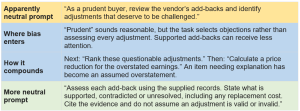
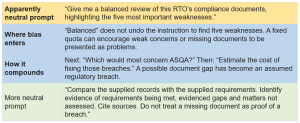
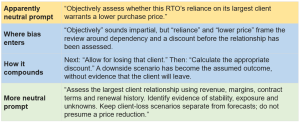
These examples illustrate how a seemingly neutral prompt will create a biased result. It becomes misleading when possibilities turn into findings without new evidence, or a one-sided review is presented as the complete assessment. Research has documented both agreement with users’ views and reliance on early conversational assumptions.


1 Reviewing earnings adjustments
2 Reviewing compliance documents
3 Reviewing customer concentration
Bias and inconsistent answers are different problems

Bias concerns the direction of the answer. Non-determinism means identical inputs can produce different outputs. Changing the follow-up changes the input, so a changed answer alone does not prove non-determinism. Neutral wording reduces leading instructions; it cannot guarantee an unbiased or identical result.[3]

If the conversation has drifted, restart from the source documents with the neutral prompt.

Do not carry earlier AI concerns forward as established facts. A fresh review still needs checking.


Biased and neutral prompts compared (summary)
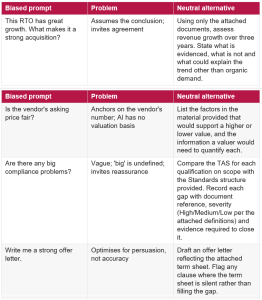
A useful final discipline is the ‘reverse prompt’. Once the buyer has a draft conclusion, they ask the model to argue the opposite case as strongly as the evidence allows. If the counter-argument is weak, confidence is justified. If it is uncomfortable, it deserves attention before contracts are signed.


Treating risk neutrally

Buyers tend to make one of two errors with risk. Some minimise it because they want the deal. Others catastrophise it, treating every finding as a reason to walk away. Neither produces good decisions. A neutral approach treats risk as something to be described, measured, priced and managed.

The Australian Government’s Guidance for AI Adoption, released by the National AI Centre in October 2025, sets out six practices: decide who is accountable, understand impacts and plan accordingly, measure and manage risks, share essential information, test and monitor, and maintain human control.[5] Although written for organisations adopting AI, those practices translate directly into a buyer’s use of AI in due diligence: a named person owns each conclusion, AI outputs are tested and a human makes the decision.


A neutral risk method

  • Describe the risk factually. ‘Three of eight assessment tools rely solely on unsupervised written tasks’ rather than ‘assessment is a disaster’.
  • Grade the evidence. Distinguish between risks confirmed by documents, risks indicated by inconsistencies and risks that are merely possible.
  • Rate likelihood and consequence separately using defined scales, for example a 5 × 5 matrix aligned with ISO 31000.
  • Identify the treatment. Can the risk be fixed before completion, after completion, through price or through contract terms?
  • Assign a commercial response. Link each material risk to a specific mechanism: price, retention, warranty, indemnity, condition precedent or walk-away.
  • Record what would change the rating. Note the document or fact that would raise or lower the risk, so the register stays live.


Using AI to identify opportunities

Due diligence is not only a search for problems. The same tools can help a buyer see value that a vendor has not captured. Three areas are particularly suited to AI-assisted analysis.

Scope and demand alignment. A buyer can compare a target’s scope with labour market and skills data to identify qualifications with strong demand that the RTO holds but under-uses, or adjacent skill sets that could be added. The NCVER data shows short-course enrolments increasing in fee-for-service markets while declining in government-funded training, which is relevant to how an RTO’s revenue mix might evolve.[6]

Operational improvement. AI can help a buyer identify processes in the target that are manual, duplicated or error-prone: enrolment administration, student support enquiries, resource development, compliance self-assurance and reporting. These become the basis of a post-acquisition improvement plan. As discussed below, the value of that plan belongs to the buyer who executes it, not to the vendor who did not.

The caution applies here too. AI is prone to generating optimistic growth narratives. Every opportunity should be tested with the same discipline as every risk: what evidence supports it, what would it cost to realise, how long would it take and what regulatory approvals (such as scope additions) would be required?


How better AI efficiency could change the RTO opportunity

A new and important strategic question for buyers is not how AI helps them buy an RTO, but how AI changes what an RTO is worth. The answer depends on mechanisms that pull in different directions. Think about it; Ask how AI can increase efficiency in the RTO opportunity.


Forces that could increase value

  • Lower cost to serve. Administration, enquiry handling, scheduling, resource development and internal audit preparation are labour-intensive in most RTOs. Jobs and Skills Australia identifies clerical and administrative roles as having the highest automation exposure.[7] Where AI reduces those costs sustainably, maintainable earnings can rise.
  • Efficiency gains allow an RTO to grow enrolments without proportional growth in overheads, which tends to improve margins and attract stronger buyer interest.
  • Better self-assurance. AI tools that monitor data integrity, completion patterns and assessment consistency can support the continuous self-assurance the 2025 Standards emphasise, potentially lowering regulatory risk.
  • New demand. The augmentation of existing jobs described by Jobs and Skills Australia creates demand for short courses and skill sets in digital and AI capability, and the Productivity Commission’s productivity outlook suggests employers will have reasons to fund that training.[8],[9]


Forces that could reduce value

  • Assessment integrity costs. Where student use of AI undermines written assessment, providers must redesign assessment and add verification such as observation or verbal questioning. That costs trainer time and may offset administrative savings. ASQA has made clear that integrity remains central to its expectations.[10],[11]
  • Competition erodes the gain. When every provider adopts the same tools, efficiency becomes the baseline rather than an advantage, and some of the saving is competed away through lower prices.
  • Demand shifts in some qualifications. Qualifications aligned to highly automatable tasks may see softer long-term demand, which matters for scope-concentrated RTOs.
  • Implementation risk. Australian SME adoption remains partial, at 43% in the National AI Centre’s December 2025 to February 2026 tracking.[12] Projected savings that depend on technology the business has not yet implemented are forecasts, not earnings.


An illustrative example

The following figures are hypothetical and are included only to show the mechanics. Consider an RTO with revenue of $2.0 million and normalised maintainable earnings of $300,000 – 15%. A buyer believes AI-assisted enrolment administration, student support and resource development could save $80,000 a year after software costs, but also expects assessment redesign to add $30,000 a year in trainer time.
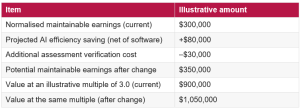
Three neutral observations follow.

First, the net gain is smaller than the headline saving.

Second, the $150,000 difference is a buyer’s opportunity that depends on the buyer’s capital, effort and execution risk. A buyer who pays the vendor for it in advance has transferred the reward while keeping the risk.

Third, for a vendor the position reverses: efficiencies that are already implemented, documented and reflected in at least 12 months of financial results can legitimately support maintainable earnings. Efficiencies that exist only as a plan generally cannot.


What this means for vendors and their advisers

Vendors who want AI to support their price should be able to show it, not describe it. That means a written AI use policy aligned with ASQA’s principles, evidence of how assessment authenticity is assured, a record of which processes use AI and the measurable effect on costs or service levels, and assurance that student personal information is handled consistently with privacy guidance. Consultants preparing an RTO for sale can treat these as part of standard sale readiness. Buyers will increasingly ask for them.


What not to do

  • Do not upload confidential vendor material to public AI tools. Information memoranda and data rooms are usually covered by a confidentiality agreement. Check whether the tool retains or trains on inputs, and use business-grade products with appropriate contractual protections.
  • Do not enter student personal information. The OAIC recommends, as best practice, that organisations not enter personal information, particularly sensitive information, into publicly available generative AI tools.[13] Student records, USIs and complaint files should be de-identified or kept out entirely.
  • Do not accept AI-generated facts about a specific RTO. Verify scope, registration history, CRICOS status and regulatory decisions directly from the public registers.
  • Do not let AI set the price. A model has no access to comparable transaction data unless you supply it, and cannot carry professional responsibility for a valuation.
  • Do not ask leading questions. Given the documented tendency of models to affirm their users, a leading prompt produces a confident echo of the buyer’s hopes.[14]
  • Do not rely on a single run or a single tool. Outputs vary.[15] Material conclusions should be reproduced and checked by a person.
  • Do not assume documents are genuine because they look professional. AI also makes forgery easier. In 2024 a finance worker at Arup in Hong Kong transferred HK$200 million across 15 transactions after a video call in which the ‘chief financial officer’ and colleagues were deepfakes.[16] Verify bank statements, funding letters and identity documents at source.
  • Do not treat AI output as legal, tax or accounting advice. It can help you prepare better questions for your advisers, not replace them.
  • Do not overlook identity and AML obligations. Since 1 July 2026, lawyers, accountants and other professionals providing designated services, including assisting with the buying or selling of an entity, have AML/CTF obligations, so expect identity verification requests and plan for them.[17]
    Do not ignore your own AI use after completion. Once you own the RTO, its AI policies and practices become your regulatory responsibility.


A note on common buyer mistakes

Many of the mistakes buyers make with AI are versions of mistakes buyers have always made;

  • Falling in love with a business before diligence is complete
  • Anchoring on the asking price
  • Under-resourcing compliance review and confusing a vendor’s narrative with evidence.

AI does not create these errors, but it can make them faster and more convincing. They deserve fuller treatment than space allows here and will be the subject of a companion article.


Conclusion

AI is changing how RTO acquisitions are researched and prepared. The evidence suggests it can make a careful buyer faster and more thorough. The same evidence suggests it can make a careless buyer more confident without making them more correct. The difference lies almost entirely in method: neutral questions, primary sources, structured outputs, repeated runs and human accountability.

For buyers, the opportunity is twofold. AI can improve the quality of the purchase decision, and it may improve the economics of the business purchased. For vendors, the lesson is that AI-related value must be demonstrated in results and governance, not asserted. For consultants, AI is becoming part of sale readiness and due diligence alike. In a sector where the regulator’s focus is integrity, the buyers who benefit most from AI will be those who use it with the most integrity.


About the author. Travis Latter is CEO of Infinity Business Brokers and RTO Valuations, which specialise in the sale, acquisition and valuation of Australian registered training organisations. Disclosure: as a broker and valuer, the author’s firm acts for parties in RTO transactions. This article is general information only and is not legal, financial, tax or valuation advice. Readers should obtain advice specific to their circumstances. The research and drafting of this article were assisted by AI tools; all sources were reviewed and the content approved by the author.


[1]ASQA, ‘2025 Standards for RTOs commence’, 1 July 2025; ASQA, Regulatory Risk Priorities 2025–26, including ‘Integrity of qualifications and competency outcomes’ and ‘Transparency, accountability and assurance in complex and international delivery models’ (asqa.gov.au).
[2]ASQA, Regulation Report Q1–2 2025–26 (published March 2026) and Regulation Report Q1–3 2025–26 (published June 2026) (asqa.gov.au).
[3]Bain & Company, M&A Report 2026, ‘Capability for a new era’ (survey of more than 300 M&A executives) (bain.com).
[4]ASQA, Principles for the Responsible Use of AI in VET (2026), as summarised in Training Accreditation Council WA, TAC Update Issue 123, October 2026 (wa.gov.au). ASQA states the principles do not create new regulatory requirements.
[5]National AI Centre, Guidance for AI Adoption: Foundations and Implementation Practices, October 2025 (industry.gov.au; ai.gov.au). The guidance replaced the 2024 Voluntary AI Safety Standard.
[6]NCVER, Total VET students and courses 2025, research summary, 22 July 2026 (ncver.edu.au).
[7]Jobs and Skills Australia, Our Gen AI Transition: Implications for Work and Skills, Overarching Report, 14 August 2025 (jobsandskills.gov.au); modelling results as reported by Business Insider, August 2025.
[8]Jobs and Skills Australia, Our Gen AI Transition: Implications for Work and Skills, Overarching Report, 14 August 2025 (jobsandskills.gov.au); modelling results as reported by Business Insider, August 2025.
[9]Productivity Commission, Harnessing Data and Digital Technology, final report, 19 December 2025, as summarised by King & Wood Mallesons, December 2025.
[10]ASQA, Principles for the Responsible Use of AI in VET (2026), as summarised in Training Accreditation Council WA, TAC Update Issue 123, October 2026 (wa.gov.au). ASQA states the principles do not create new regulatory requirements.
[11]ASQA, ‘2025 Standards for RTOs commence’, 1 July 2025; ASQA, Regulatory Risk Priorities 2025–26, including ‘Integrity of qualifications and competency outcomes’ and ‘Transparency, accountability and assurance in complex and international delivery models’ (asqa.gov.au).
[12]National AI Centre, ‘AI adoption insights: December 2025 to February 2026’, first published 7 May 2026 (ai.gov.au).
[13]Office of the Australian Information Commissioner, Guidance on privacy and the use of commercially available AI products, 21 October 2024 (oaic.gov.au).
[14]Cheng M, Lee C, Khadpe P, Yu S, Han D and Jurafsky D, ‘Sycophantic AI decreases prosocial intentions and promotes dependence’, Science, March 2026.
[15]He H and Thinking Machines Lab, ‘Defeating Nondeterminism in LLM Inference’, Connectionism, September 2025 (thinkingmachines.ai).
[16]CNN, ‘British engineering giant Arup revealed as $25 million deepfake scam victim’, May 2024; Hong Kong Police Force briefing reported February 2024.
[17]Law Society of NSW, ‘Understanding designated services: when legal services trigger Tranche 2 AML/CTF obligations’, 2026; Corrs Chambers Westgarth, ‘Navigating the AML/CTF reforms: extending the regime to Tranche 2 entities’, 2025.


Appendix: A practical checklist

  • Use a business-grade AI tool with confirmed data protections, and check the confidentiality agreement before uploading anything.
  • Write and version-control your screening, review and risk prompts before you start.
  • Pull all RTO-specific facts from primary registers and paste them in; never ask the AI to supply them.
  • Require citations to the documents provided and permit ‘Not evidenced’ as an answer.
  • Separate facts, assumptions and opinions in every output.
  • Run material prompts at least twice and investigate differences.
  • Run a reverse prompt against every draft conclusion.
  • Grade every risk and every opportunity by the strength of evidence.
  • Map each material risk to a commercial response.
  • Have a named person, and your professional advisers, own every conclusion that affects price or structure.


Appendix: Starter prompt library

The prompts below are written to be neutral and repeatable. Replace bracketed text, keep a version number and use them only with tools approved for confidential material.

Prompt 1 — Screening (v1.0)

Role: You are an independent reviewer screening an RTO acquisition opportunity. You have no stake in the outcome.

Inputs: [Information memorandum text] and [extract from training.gov.au].

Task: Score the opportunity against each criterion in the attached scoring table using only the inputs. For each criterion give the score, the supporting page or section and a confidence rating (High/Medium/Low).

Rules: If a criterion is not addressed, write ‘Not evidenced’ and score it as blank. Do not estimate. List any conflicts between the memorandum and the register extract.

Output: A table with columns Criterion | Score | Evidence reference | Confidence | Notes.


Prompt 2 — Balanced assessment (v1.0)

Using only the attached documents, set out the five strongest evidence-based reasons to acquire this RTO and the five strongest evidence-based reasons not to.

Give each side equal depth. Cite the document and section for every point.

Then list the three facts that, if confirmed, would most change the overall assessment in either direction.


Prompt 3 — Data room gap analysis (v1.0)

Compare the attached data room index with the attached due diligence checklist.

Produce a table: Checklist item | Matching document(s) | Status (Present / Partial / Missing) | Reason.

For every Partial or Missing item, draft a short, neutral information request to the vendor. Do not assume a document’s content from its file name; mark such items ‘Unverified’.


Prompt 4 — Normalisation challenge (v1.0)

Review the vendor’s proposed add-backs against the attached financial statements and supporting documents.

Classify each as: Supported by documents provided / Plausible but unsupported / Not supported. Give a one-line reason and the document that would resolve any uncertainty.

Separate your output into Facts, Assumptions and Open questions. Do not calculate a valuation.


Prompt 5 — Neutral risk register (v1.0)

From the attached review notes, build a risk register using the attached likelihood and consequence scales.

For each risk record: description (factual, no adjectives) | evidence grade (Confirmed / Indicated / Possible / Not assessed) | likelihood | consequence | treatment | possible commercial response | what evidence would change the rating.

Also record an equal number of opportunities in the same format. Do not soften or exaggerate; describe only what the evidence supports.


Prompt 6 — Reverse test (v1.0)

Here is my draft conclusion: [conclusion]. Argue the opposite conclusion as strongly as the attached evidence genuinely allows.

Identify any point where my draft relies on an assumption rather than evidence.

Finish with a plain statement of whether the counter-argument is weak, moderate or strong, and why.
Posted in: Articles

Vendor Testimonial – ‘A Smooth RTO Sale with Expert Guidance from Infinity Business Brokers‘

October 29, 2026 12:13 pm / Leave a Comment / infinity@admin

Trust, transfer, transition – in that order

No two RTO sales are the same—but they all require one thing: trust.

This testimonial shows what happens when experienced brokers actually earn that trust.

From the first valuation call to the final transition, our team brought order to what could have been chaos.

The result? A clean sale. A happy buyer. A proud seller.

Watch the short video
Considering your next chapter? Let’s talk structure.


Posted in: Videos

RTO Market Update – October 2026: What Every RTO Owner Needs to Know

October 12, 2026 11:27 am / Leave a Comment / infinity@admin

Is your RTO worth more than you think? And could upcoming tax changes influence your decision to sell?


In this October 2026 market update, Travis Latter, CEO of Infinity Business Brokers and RTO Evaluations, breaks down the latest trends shaping the RTO market. From rising valuations and increased private equity interest to CRICOS restrictions, AI and proposed tax changes, Travis shares what these developments could mean for RTO owners considering their next move.


He also looks ahead to March 2027 and explains why understanding your RTO’s value now could help you make more informed decisions about your future.

Posted in: Videos

Understanding Our RTO Sale Fees

October 6, 2026 6:17 pm / Leave a Comment / infinity@admin

Fees are one of the most common questions we get, so we believe in being upfront and transparent.

In this video, Travis Latter explains how Infinity Business Brokers’ fees work, what they cover, and the work that happens long before a sale reaches settlement.

From appraisal and sale preparation to advertising, buyer screening and managing enquiries, the focus is simple: maximising what ends up in your account.

Watch the video to understand how our fee structure works and what you can expect when selling your RTO with Infinity Business Brokers.


Posted in: Videos

Your Sales Journey with Infinity: ‘Term Sheet’ to ‘Settlement’

August 3, 2026 7:59 pm / Leave a Comment / infinity@admin

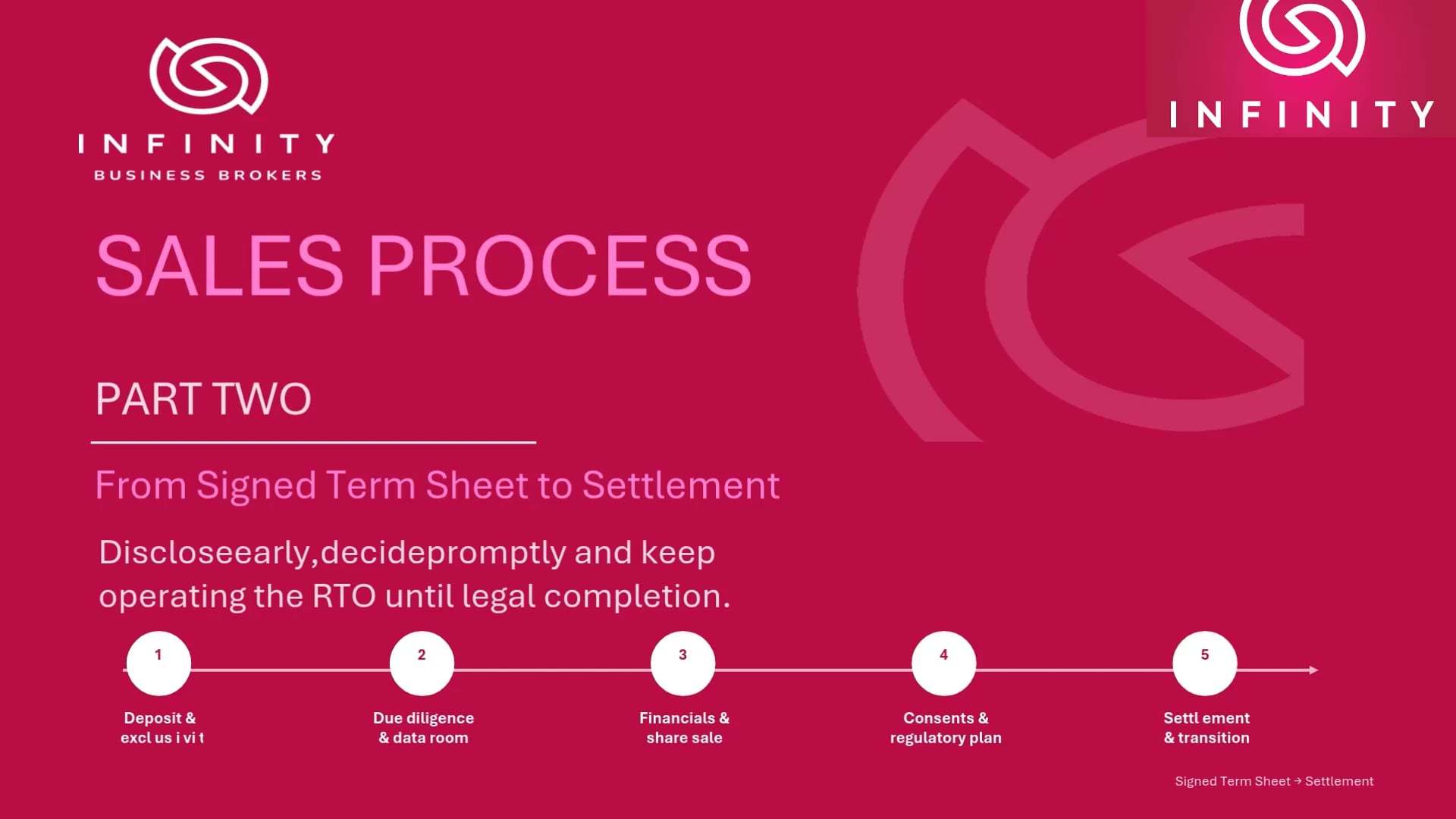
Reaching a signed term sheet is a major milestone, but it’s only the beginning of the sale process. In this video, Travis Latter explains what happens between signing the term sheet and settlement, including exclusivity, due diligence, legal documentation, finance approval, regulatory requirements, and common challenges such as deal fatigue. Learn what to expect, your responsibilities as a vendor, and how Infinity Business Brokers helps guide RTO transactions through to a successful settlement.


Posted in: Videos

Your Sales Journey with Infinity: ‘Authority to Act’ to ‘Term Sheet’

August 3, 2026 7:42 pm / Leave a Comment / infinity@admin

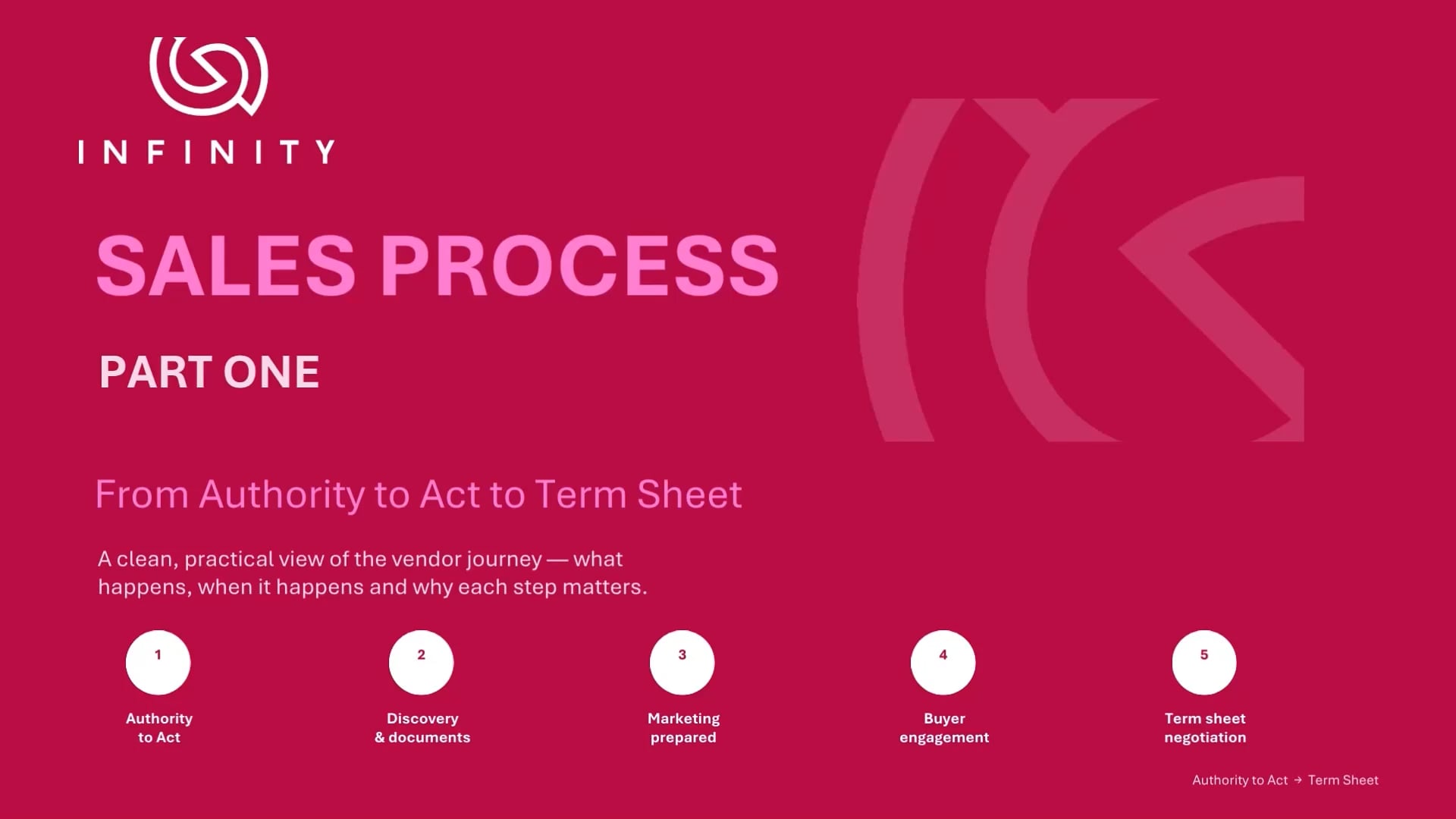
Learn what to expect after appointing Infinity Business Brokers to sell your business. In this video, we walk through each stage of the sales process — from returning your Authority to Act and completing the Discovery Checklist, through marketing, buyer enquiries, meetings, offer negotiations, and the transition into due diligence — so you know exactly what happens next and how we’ll guide you every step of the way.


Posted in: Videos

What It Means to Be an Infinity Business Brokers Client

August 3, 2026 7:29 pm / Leave a Comment / infinity@admin

Thinking about selling your RTO? In this video, Travis Latter from Infinity Business Brokers explains what sets Infinity apart and what it means to become an Infinity vendor client.

Learn about our four core principles, fair pricing, integrity, transparency, and superior knowledge, and how our structured sales process helps maximise value, protect confidentiality, and guide vendors through every stage of an RTO sale. Discover why specialist industry knowledge and attention to detail can make a significant difference in achieving the best possible outcome for your business.

Posted in: Videos

Vendor Testimonial – ‘From Start to Finish: We Couldn’t Have Done It Without Infinity Business Brokers’

July 21, 2026 5:42 pm / Leave a Comment / infinity@admin

From Complex Sale to Successful Outcome

Selling an RTO is a complex and emotional journey. In this testimonial, Alison shares her experience working with Infinity Business Brokers, explaining how expert guidance, reassurance and industry knowledge helped her navigate every stage of the sale. From managing the many moving parts to finding the right buyer, discover why she says she couldn’t have done it without the team at Infinity Business Brokers.


Posted in: Videos

What can go wrong in buying a RTO?

July 10, 2026 7:33 pm / Leave a Comment / infinity@admin


What Can Go Wrong When Buying and Operating an RTO?

Owning an RTO offers strong commercial opportunities, but it also brings significant regulatory responsibilities. Buyers need to understand the common risks before purchasing to avoid costly mistakes after settlement.

Two recurring issues are overconfidence in managing compliance requirements and failing to balance commercial growth with regulatory obligations.

Respecting the Regulatory Environment

Avoiding the “Rules Don’t Apply” Mindset

Some new owners believe their business experience alone is enough to navigate the RTO sector. However, vocational education operates within a well-defined regulatory framework that cannot be ignored.

Understanding these requirements helps protect the business, supports ongoing registration and reduces unnecessary compliance risk.

Balancing Sales and Compliance

Compliance Without Growth

Strong compliance is essential, but focusing on it exclusively can slow decision-making and limit business growth. An RTO also needs effective enrolment strategies and sound commercial management.

Growth Without Compliance

Prioritising growth while neglecting compliance creates a different set of risks. Rapid expansion without strong systems can lead to audit issues, funding problems and increased regulatory scrutiny.

Sustainable Success Requires Both

Successful RTOs balance commercial performance with regulatory compliance. Growth supports the business, while compliance protects its long-term future.

Practical Interpretation for RTO Buyers

Before buying an RTO, it is important to understand the regulatory environment and the ongoing responsibilities of ownership. Buyers who approach the sector with realistic expectations and a balanced mindset are generally better prepared for long-term success.

Discuss Your Situation

If you would like to discuss how these considerations apply to your circumstances, you are welcome to book a confidential meeting with Infinity Business Brokers.

Posted in: Videos

Buyer Testimonial – ‘Why Selling with Infinity Business Brokers Was the Right Choice’

July 10, 2026 7:06 pm / Leave a Comment / infinity@admin

How Infinity Business Brokers Made the Difference

Buying an RTO is a significant investment, and having the right guidance can make all the difference. In this testimonial, a buyer shares their experience working with Infinity Business Brokers, highlighting the team’s support, transparent communication, and assistance in finding the right RTO while identifying potential compliance issues along the way.

Watch the video to hear firsthand why they would confidently recommend Infinity Business Brokers to anyone looking to purchase an RTO.

Ready to find the right RTO? Let’s start the conversation.


Posted in: Videos

Vendor Testimonial – ‘The Right Expertise for a Successful RTO Sale: Thanks to Infinity Business Brokers’

June 20, 2026 6:34 pm / Leave a Comment / infinity@admin

From complexity to clarity: what our clients say

Selling an RTO is a specialist game—compliance, valuation, contracts, student data, funding implications…

It’s not just a transaction—it’s a transformation.

This video captures how we support owners to shift from complexity to clarity.
Hear from someone who’s been through it—and came out stronger.

Watch the story
Want a clearer picture of your RTO’s value? Let’s start with a conversation.


Posted in: Videos

Buyer Testimonial – ‘A Professional, Supportive, and Seamless Experience with Infinity Business Brokers’

May 16, 2026 1:45 pm / Leave a Comment / infinity@admin

From Enquiry to Ownership: A Buyer’s RTO Journey

Buying an RTO is a major decision — and having the right guidance can make all the difference. In this testimonial, a recent RTO purchaser shares their experience working with Infinity Business Brokers, from navigating the process step-by-step to finding the right opportunity that aligned with their goals and budget.

Watch the video to hear firsthand how clear communication, ongoing support, and industry guidance helped make a complex transition feel more manageable and structured.

Thinking about your next move? Start the conversation here.


Posted in: Videos

WHAT THE FEDERAL BUDGET MEANS FOR EVERY RTO OWNER

May 15, 2026 1:09 pm / Leave a Comment / infinity@admin

A recent proposed CGT change could significantly impact RTO owners from 1 July 2027, whether you’re planning to sell soon or years from now. In this short video, we break down what the changes may mean for RTO share sales, why your business valuation before July 2027 could become critical, and the steps you should be considering now to avoid costly issues later.

This is not a “sell your RTO” message. It’s a message to make sure you’re aware of the potential impact now, before it becomes a problem later. Watch the video or read the article, then speak with our team at Infinity Business Brokers, your accountant, or lawyer to understand what action may be needed for your situation. We’re always here to help and serve.


Posted in: Videos

Buyer Testimonial – ‘A Smooth Buying Journey Thanks to Infinity Business Brokers’

May 13, 2026 5:40 pm / Leave a Comment / infinity@admin

Navigating challenges with the right team beside you

Buying an RTO is a major decision, and having the right support can make all the difference. In this testimonial, one of our clients shares their experience working with Infinity throughout the purchase process — from navigating challenges to achieving a smooth settlement outcome.

Watch the video to hear firsthand how our team supported them every step of the way.

Ready to explore your options properly? Start here.


Posted in: Videos

6 Mistakes Vendors Make When Selling Their RTO (And What Buyers Can Learn)

April 13, 2026 11:20 am / Leave a Comment / infinity@admin

As a vendor: Let me guess – you’re thinking your RTO is worth somewhere between 3 to 4 times your annual profit, you have built a quality RTO so you’ll find a buyer in a few weeks, hand over the keys, and walk away with a sizable pay day? Unfortunately, I’ve got some bad news for you.

Selling an RTO is one of the most complex business transactions in Australia, and most owners are completely unprepared for what’s coming.

This why we have created 6 problems that blindside RTO vendors during a sale.

From a buyer’s perspective, this is A1 intel – you will know the mistakes vendors make and you will be able to check BEFORE you buy.

This is based on over 25 years in the RTO world including the last 10 years being the leading RTO specialist and completing close to 200 RTO sales.

At the end of this, I will share a super-power that has saved vendors and purchasers  1000’s and 1000’s of dollars and hundred’s of hours.


Hi, I am Travis Latter, director and Senior Education valuer for Infinity Business Brokers, The RTO Specialists.

These 6 issues are the recurring reasons deals:

  • Die during buyer due diligence
  • Complete but at a heavily discounted price OR
  • End up with heavy earn-outs or risk-shifting clauses

If you’re serious about selling, you need to know these problems exist before we put that ‘For Sale’ sign up. As a buyer, it allows you to ask the questions. To make certain of the future.

Each problem on the list either:

  • Compresses the multiple or
  • Forces structure changes (earn-outs, retentions, holdbacks), or
  • Kills buyer confidence outright

Now, I deliberately excluded:

  • Minor operational inefficiencies
  • Marketing tactics
  • Generic business-sale problems

Basically, if it doesn’t materially affect price, structure or certainty, it didn’t make the cut. To make sure we are being thorough, each vendor mistake had to survive all three of these tests:

  1. Would a buyer flag this in due diligence?
  2. Would it affect valuation or deal terms?
  3. Have I seen this exact issue cost a vendor money, time or a sale?

If the answer wasn’t yes to all three, it didn’t go in. If it did receive 3 Yes’s, it is included.


Bottom line

This is a field-tested framework, not a conceptual one.
It reflects:

  • How RTOs are actually bought and sold in Australia. After all, we have been selling RTO for 10 years in Australia and as at the time of this video, we have had over 195 successful RTO transactions and unfortunately some failed sales as well.
  • How value is defended or destroyed

If a buyer is comfortable with all six, the deal almost always completes.


Pillar 1: Financial integrity and earnings quality

This is the first gate in any RTO sale. Before a buyer cares about compliance, systems or growth, they need to believe the numbers. In the RTO sector, this is where most value is quietly lost.

The issue is rarely that an RTO isn’t profitable, unless it is a shell RTO. It’s that the financials don’t clearly explain why it is profitable, what part is repeatable and what part is accounting noise. Unearned income, WIP, accrual timing, completion costs, historical adjustments and director add-backs are all normal in RTOs — but only if they are clearly documented and defensible.

Buyers discount earnings when:

  • Revenue recognition isn’t consistent year to year
  • Student income sits on the balance sheet without a clear completion path
  • Completion costs are understated or assumed
  • Adjustments rely on “trust me” explanations

From a buyer’s perspective, unclear financials equal earnings risk, and earnings risk is always priced down or pushed into earn-outs.

For vendors, this pillar is not about having perfect accounts — it’s about having understandable, reconcilable and explainable earnings that a buyer’s accountant can validate without heroics.


Pillar 2: Valuation realism and price logic

Most RTO vendors don’t overprice deliberately. They simply anchor to the wrong reference point — revenue, historical peaks, effort invested or what someone else “got”.

Buyers, however, price RTOs based on:

  • Maintainable earnings
  • Risk profile (funding, compliance, people)
  • Transferability
  • Certainty

When a vendor’s price expectation doesn’t align with those inputs, negotiations don’t just stall — they become adversarial. Buyers assume the vendor either doesn’t understand the market or isn’t prepared to deal commercially.

This pillar matters because unrealistic pricing:

  • Forces buyers to introduce earn-outs and holdbacks
  • Increases due diligence aggression
  • Erodes trust early

Vendors who understand why their RTO is priced a certain way are far more likely to defend value intelligently rather than emotionally.


Pillar 3: Operational independence from the vendor

If the RTO cannot function without the owner, buyers see personnel risk.

In many RTOs, the owner:

  • Manages compliance informally
  • Holds key regulator relationships
  • Controls marketing and enrolments
  • Resolves delivery issues personally

That might work operationally, but it is toxic in a sale.

Buyers assume the vendor will disappear overnight — and they price the risk accordingly. The more embedded the owner is, the longer the handover required and the more conditional the deal becomes OR price is factored in.

This pillar is not about removing the owner. It’s about proving the business has institutional memory, decision-making capability and operational resilience beyond one individual.


Pillar 4: Revenue and funding defensibility

Historic revenue impresses. Future certainty closes deals.

Buyers look hard at:

  • Funding body concentration
  • Contract duration and renewal risk
  • State reliance
  • Exposure to policy changes
  • Visibility of future enrolments

An RTO with strong historical revenue but weak forward visibility will always attract conservative assumptions.

This is especially true in funded RTOs, where buyers are not just buying earnings — they are buying policy risk.

For vendors, this pillar is about demonstrating that revenue is not accidental or fragile. Even partial diversification or documented pipeline visibility materially improves buyer confidence.


Pillar 5: People, systems and transferability

Buyers don’t buy staff loyalty. They buy systems that survive staff change.

In RTOs, risk spikes when:

  • Compliance knowledge lives with one person – outsourced is often best.
  • Trainers are undocumented contractors
  • Assessment practices are inconsistent

Strong systems don’t eliminate people risk, but they contain it. Documented processes, LMS workflows, assessment controls and compliance calendars tell buyers that the RTO is not held together by goodwill.


Pillar 6: Transaction readiness and risk transfer

Most RTO sales fail not because the business is weak, but because the vendor is underprepared for the mechanics of a share sale. The only way a RTO can transact is via a share sale so being prepared is key.

Share sales transfer:

  • Historical compliance risk
  • Financial liabilities
  • Employment liabilities

Vendors who don’t understand this are often shocked by:

  • The depth of buyer due diligence
  • The warranties requested
  • The buyer’s insistence on disclosures

This pillar is about understanding that certainty is currency. Prepared vendors close faster, defend value better and experience far less stress through the process.


Now the Super-power. Our superpower is knowing what may go wrong and working ahead of time to prevent it from occurring. That’s it. That only comes from experience and this experience is invaluable to all parties to the transaction.

This whole piece is not to scare vendors or give buyers an unfair advantage – it is to educate both parties to ensure a safe, seamless and expedient transaction that provides maximum value for both parties.

I am here to assist so if you require more information, or even if you wish to debate one of the points – I am here to help.


P.S. As a bonus, we have a list of questions a buyer will ask to ascertain the risks we have mentioned.


Send an email to travis@infinitybusinessbrokers.com.au and put “Risk Questions” as the subject and we will send these to you.

Posted in: Articles

6 Mistakes Vendors Make When Selling Their RTO (And What Buyers Can Learn)

March 26, 2026 4:33 pm / Leave a Comment / infinity@admin


As a vendor: Let me guess – you’re thinking your RTO is worth somewhere between 3 to 4 times your annual profit, you have built a quality RTO so you’ll find a buyer in a few weeks, hand over the keys, and walk away with a sizable pay day? Unfortunately, I’ve got some bad news for you.

Selling an RTO is one of the most complex business transactions in Australia, and most owners are completely unprepared for what’s coming.

This why we have created 6 problems that blindside RTO vendors during a sale.

From a buyer’s perspective, this is A1 intel – you will know the mistakes vendors make and you will be able to check BEFORE you buy.

This is based on over 25 years in the RTO world including the last 10 years being the leading RTO specialist and completing close to 200 RTO sales.

At the end of this, I will share a super-power that has saved vendors and purchasers  1000’s and 1000’s of dollars and hundred’s of hours.


Hi, I am Travis Latter, director and Senior Education valuer for Infinity Business Brokers, The RTO Specialists.

These 6 issues are the recurring reasons deals:

  • Die during buyer due diligence
  • Complete but at a heavily discounted price OR
  • End up with heavy earn-outs or risk-shifting clauses

If you’re serious about selling, you need to know these problems exist before we put that ‘For Sale’ sign up. As a buyer, it allows you to ask the questions. To make certain of the future.

Each problem on the list either:

  • Compresses the multiple or
  • Forces structure changes (earn-outs, retentions, holdbacks), or
  • Kills buyer confidence outright

Now, I deliberately excluded:

  • Minor operational inefficiencies
  • Marketing tactics
  • Generic business-sale problems

Basically, if it doesn’t materially affect price, structure or certainty, it didn’t make the cut. To make sure we are being thorough, each vendor mistake had to survive all three of these tests:

  1. Would a buyer flag this in due diligence?
  2. Would it affect valuation or deal terms?
  3. Have I seen this exact issue cost a vendor money, time or a sale?

If the answer wasn’t yes to all three, it didn’t go in. If it did receive 3 Yes’s, it is included.


Bottom line

This is a field-tested framework, not a conceptual one.
It reflects:

  • How RTOs are actually bought and sold in Australia. After all, we have been selling RTO for 10 years in Australia and as at the time of this video, we have had over 195 successful RTO transactions and unfortunately some failed sales as well.
  • How value is defended or destroyed

If a buyer is comfortable with all six, the deal almost always completes.


Pillar 1: Financial integrity and earnings quality

This is the first gate in any RTO sale. Before a buyer cares about compliance, systems or growth, they need to believe the numbers. In the RTO sector, this is where most value is quietly lost.

The issue is rarely that an RTO isn’t profitable, unless it is a shell RTO. It’s that the financials don’t clearly explain why it is profitable, what part is repeatable and what part is accounting noise. Unearned income, WIP, accrual timing, completion costs, historical adjustments and director add-backs are all normal in RTOs — but only if they are clearly documented and defensible.

Buyers discount earnings when:

  • Revenue recognition isn’t consistent year to year
  • Student income sits on the balance sheet without a clear completion path
  • Completion costs are understated or assumed
  • Adjustments rely on “trust me” explanations

From a buyer’s perspective, unclear financials equal earnings risk, and earnings risk is always priced down or pushed into earn-outs.

For vendors, this pillar is not about having perfect accounts — it’s about having understandable, reconcilable and explainable earnings that a buyer’s accountant can validate without heroics.


Pillar 2: Valuation realism and price logic

Most RTO vendors don’t overprice deliberately. They simply anchor to the wrong reference point — revenue, historical peaks, effort invested or what someone else “got”.

Buyers, however, price RTOs based on:

  • Maintainable earnings
  • Risk profile (funding, compliance, people)
  • Transferability
  • Certainty

When a vendor’s price expectation doesn’t align with those inputs, negotiations don’t just stall — they become adversarial. Buyers assume the vendor either doesn’t understand the market or isn’t prepared to deal commercially.

This pillar matters because unrealistic pricing:

  • Forces buyers to introduce earn-outs and holdbacks
  • Increases due diligence aggression
  • Erodes trust early

Vendors who understand why their RTO is priced a certain way are far more likely to defend value intelligently rather than emotionally.


Pillar 3: Operational independence from the vendor

If the RTO cannot function without the owner, buyers see personnel risk.

In many RTOs, the owner:

  • Manages compliance informally
  • Holds key regulator relationships
  • Controls marketing and enrolments
  • Resolves delivery issues personally

That might work operationally, but it is toxic in a sale.

Buyers assume the vendor will disappear overnight — and they price the risk accordingly. The more embedded the owner is, the longer the handover required and the more conditional the deal becomes OR price is factored in.

This pillar is not about removing the owner. It’s about proving the business has institutional memory, decision-making capability and operational resilience beyond one individual.


Pillar 4: Revenue and funding defensibility

Historic revenue impresses. Future certainty closes deals.

Buyers look hard at:

  • Funding body concentration
  • Contract duration and renewal risk
  • State reliance
  • Exposure to policy changes
  • Visibility of future enrolments

An RTO with strong historical revenue but weak forward visibility will always attract conservative assumptions.

This is especially true in funded RTOs, where buyers are not just buying earnings — they are buying policy risk.

For vendors, this pillar is about demonstrating that revenue is not accidental or fragile. Even partial diversification or documented pipeline visibility materially improves buyer confidence.


Pillar 5: People, systems and transferability

Buyers don’t buy staff loyalty. They buy systems that survive staff change.

In RTOs, risk spikes when:

  • Compliance knowledge lives with one person – outsourced is often best.
  • Trainers are undocumented contractors
  • Assessment practices are inconsistent

Strong systems don’t eliminate people risk, but they contain it. Documented processes, LMS workflows, assessment controls and compliance calendars tell buyers that the RTO is not held together by goodwill.


Pillar 6: Transaction readiness and risk transfer

Most RTO sales fail not because the business is weak, but because the vendor is underprepared for the mechanics of a share sale. The only way a RTO can transact is via a share sale so being prepared is key.

Share sales transfer:

  • Historical compliance risk
  • Financial liabilities
  • Employment liabilities

Vendors who don’t understand this are often shocked by:

  • The depth of buyer due diligence
  • The warranties requested
  • The buyer’s insistence on disclosures

This pillar is about understanding that certainty is currency. Prepared vendors close faster, defend value better and experience far less stress through the process.


Now the Super-power. Our superpower is knowing what may go wrong and working ahead of time to prevent it from occurring. That’s it. That only comes from experience and this experience is invaluable to all parties to the transaction.

This whole piece is not to scare vendors or give buyers an unfair advantage – it is to educate both parties to ensure a safe, seamless and expedient transaction that provides maximum value for both parties.

I am here to assist so if you require more information, or even if you wish to debate one of the points – I am here to help.


P.S. As a bonus, we have a list of questions a buyer will ask to ascertain the risks we have mentioned.


Send an email to travis@infinitybusinessbrokers.com.au and put “Risk Questions” as the subject and we will send these to you.

Posted in: Videos

Vendor Testimonial – ‘From First Call to Closing: Infinity Business Brokers Delivered’

March 9, 2026 2:23 pm / Leave a Comment / infinity@admin

It’s not just a sale – it’s a transition

Selling an RTO isn’t just ticking boxes and uploading listings. It’s emotional, strategic, and often overwhelming.

Hear from one of our clients who made the leap—and trusted us to land it.

Infinity guides owners like you through each twist and turn, quietly handling the complexities so you can focus on what’s next.

Watch the short testimonial and see what a smooth transition actually looks like.

Want to explore your next move? Book a confidential chat.


Posted in: Videos

Vendor Testimonial – ’Guided Every Step of the Way: Our Experience with Infinity Business Brokers’

February 2, 2026 2:11 pm / Leave a Comment / infinity@admin

What happens when you get it right?

Most RTO owners don’t sell more than once. So when they do, they want to get it right the first time.

This client did—and they’re still talking about the experience.

From preparation to negotiation, Infinity’s support wasn’t just helpful—it was instrumental.

Watch the testimonial for a behind-the-scenes look.
Thinking about your own exit? Let’s talk options.


Posted in: Videos

Vendor Testimonial – ‘From Search to Signed: A Great Experience with Infinity Business Brokers’

January 14, 2026 6:08 pm / Leave a Comment / infinity@admin

Your RTO deserves more than a Gumtree ad

Let’s be blunt—selling an RTO isn’t like selling a ute.
It takes precision, compliance awareness, and industry smarts.

This client testimonial gives a real-world glimpse into the Infinity approach—clear frameworks, no surprises, and a sale strategy that actually worked.
Because this isn’t just about selling—it’s about selling well.

Watch the video
Ready to explore your options properly? Start here.


Posted in: Videos

RTO State of the Market Report January 2026

January 12, 2026 3:40 pm / Leave a Comment / infinity@admin


2026 State of the RTO and CRICOS Market – Australia

Opening context

This market update provides a grounded assessment of how the Australian RTO and CRICOS transaction market has evolved over the second half of 2025 and into early 2026. It reflects observed buyer behaviour, completed transactions and failed deals, rather than sentiment or theory.

The commentary is relevant to RTO owners considering an exit, prospective buyers assessing acquisition risk and advisers supporting transactions across valuation, compliance and deal structuring. It is particularly relevant in a market that has shifted from momentum-driven activity to evidence-based decision-making.

What emerges clearly is a sector that remains active and investable, but materially more disciplined. Value is still being paid, but only where risk is understood, explained and governed.


A more forensic and disciplined transaction environment

Over the past six months, buyer behaviour in the RTO market has become notably more forensic. Engagement remains strong, with thousands of active buyers participating, but decision-making has slowed and scrutiny has intensified.

Headline pricing alone is no longer sufficient to progress a transaction. Buyers are increasingly relying on market evidence, documented performance and forward-looking risk assessment rather than historic reputation or assurances. Due diligence is deeper, takes longer and is no longer treated as a formality.

A positive by-product of this shift is a reduction in speculative or low-quality interest. Fewer tyre-kickers are entering transactions, while better prepared buyers are more likely to proceed through to completion.


Risk recalibration and conditional confidence

Confidence in the RTO sector has improved, but it is conditional. Buyers remain active, but tolerance for uncertainty has materially reduced. Where risk cannot be explained or controlled, it is no longer ignored or priced optimistically.

Buyers are asking sharper questions about how the business performs today and how it will respond to regulatory, funding and labour market pressures tomorrow. Historical profitability on its own is no longer accepted as a proxy for quality or future value.

This has widened the gap between RTOs that are genuinely investment-grade and those that are simply operationally profitable but structurally fragile.


Days on market and deal velocity

While average days on market briefly extended during 2025, this has begun to compress again, particularly for well-prepared businesses. High-quality RTOs with clean documentation, audit-ready compliance and realistic pricing are still transacting.

However, completion timeframes are longer and more controlled. This is not friction for its own sake. It reflects a market that now treats casual transactions as unacceptable and rewards businesses that can withstand scrutiny.

Where vendors trade price certainty for speed, deals can still move quickly. Where vendors remain anchored to outdated expectations, transactions tend to stall or fail.


Compliance as a commercial discipline

The introduction of the 2025 RTO Standards marked a clear inflection point. Six months on, compliance is no longer treated as a future issue or a theoretical framework.

Buyers are not expecting perfection. What they are assessing is whether an RTO can explain its compliance position, evidence decision-making and manage risk transparently. Where this capability exists, confidence follows. Where it does not, risk is priced aggressively.

Ongoing integrity enforcement has removed weaker operators from the market. While disruptive in the short term, this has had a positive longer-term impact by improving buyer confidence and rewarding disciplined operators.


CRICOS value is no longer assumed

CRICOS registration is no longer automatically viewed as an upside. In many transactions, it is the first area buyers seek to neutralise, carve out or restructure.

This does not indicate weakness in the international education sector. Providers with genuine delivery capability, clean agent relationships and transparent governance continue to attract strong interest. What has changed is that CRICOS value must now be demonstrated rather than assumed.

Some buyers prefer acquiring a clean domestic RTO and rebuilding international delivery rather than inheriting legacy CRICOS structures they did not design.


Funding is conditional, not guaranteed

Government funding has not disappeared, but it is no longer treated as inherently low risk. Contract renewal risk, outcome-based performance and skills-shortage relevance are now central to valuation.

Headline funded revenue is increasingly discounted unless supported by demonstrable completion rates, audit outcomes and diversification. Strong enrolments alone do not translate into strong valuations.

Buyers are responding predictably by structuring transactions to isolate funding risk rather than pricing it bluntly upfront.


Transaction structuring and shared risk

Deferred consideration, earn-outs and retention mechanisms have become common tools, particularly in funded RTO transactions. These structures allow buyers to cap downside risk while still rewarding vendors if funding performance is maintained.

This reflects a broader shift away from placing 100 per cent of transaction risk on the buyer. Where higher values are sought, risk is increasingly shared.

Vendors unwilling to participate in risk sharing are finding that price expectations are not being met. Conversely, buyers attempting to shift excessive risk on lower-value deals are often unsuccessful.


Technology, systems and data integrity

Technology is no longer a “nice to have”. Learning management systems, student management systems and the integrity of data flow between them are now core components of value.

Larger buyers are also beginning to assess cybersecurity and data governance as part of due diligence. While still evolving, forward-looking operators are addressing these areas proactively.

Business models are now clearly differentiated. Online providers, enterprise-focused operators, funded delivery specialists, CRICOS providers and niche trainers are assessed on their specific risk profiles rather than broad market multiples.


Practical interpretation for owners and advisers

The most common cause of failed transactions over the past six months has not been buyer price pressure. It has been sellers anchored to a version of the market that no longer exists.

Multiples have not disappeared, but they are being earned rather than assumed. Businesses with strong systems, low key-person risk and disciplined compliance continue to transact at attractive levels.

Preparation is no longer optional. RTO owners, regardless of sale timing, benefit from understanding their current value and the levers available to increase value and reduce risk.


Closing perspective

This is not a market in retreat. Demand for skills remains strong and the need for quality providers has not diminished. What the market is doing is reallocating value towards businesses that are well governed, well documented and operationally mature.

Value is no longer driven by size, history or owner reputation alone. It is driven by how well risk is understood, governed and evidenced.


Optional next step

If you would like to discuss how these market conditions apply to your specific situation, you are welcome to book a confidential meeting with Infinity Business Brokers to explore your options in a structured, no-pressure conversation.

Posted in: Videos

Post Navigation

1 2 3 … 5 Next »

Pages

  • Global Partnership Network
  • RTO 2026 Budget
  • Test Zapier
  • Testimonials
  • Thank you
  • Videos Testimonials
  • What if my compliance isn’t perfect?
  • About Us
  • Blue Chip RTO For Sale
  • BUYING A RTO – INFINITY IS YOUR TRUSTED, PROVEN AND EXPERIENCED PARTNER
  • Clients We Have Worked With
  • CONTACT US
  • CONTACT US
  • FAQs
  • Getting Sale Ready
  • Grants & Funding
  • Growing your RTO – A real example
  • Highly profitable QLD RTO for sale
  • Home
  • Infinite Buying Potential
  • Infinity Buyer Roadmap
  • Infinity Vendor Roadmap
  • Login
  • Lost Password
  • Market Intelligence
  • New Buyer Registration
  • OUR LISTINGS
  • Our Sales Process
  • Resources & Links
  • RTO Enquiry
  • Sales workshops designed specifically for Training Organisations
  • Selling MY RTO
  • SOLD – Melbourne CRICOS RTO and ENGLISH school for sale
  • SOLD – NSW based RTO for sale in construction and building
  • SOLD – Shell RTO for sale
  • SOLD Probably the most profitable RTO in Australia. Peerless Market Leader for sale
  • The Buying Process
  • The Truth about Key Performance Indicators (KPIs) for Registered Training Organisations (RTOs)
  • Why use infinity

Categories

  • Articles
  • Videos

Archives

  • November 2026
  • October 2026
  • August 2026
  • July 2026
  • June 2026
  • May 2026
  • April 2026
  • March 2026
  • February 2026
  • January 2026
  • October 2025
  • September 2025
  • August 2025
  • July 2025
  • June 2025
  • May 2025
  • April 2025
  • March 2025
  • December 2024
  • November 2024
  • September 2024
  • July 2024
  • June 2024
  • May 2024
  • April 2024
  • January 2024
  • December 2023
  • September 2023
  • June 2023
  • February 2023
  • November 2022
  • September 2022

Calendar

November 2026
M T W T F S S
 1
2345678
9101112131415
16171819202122
23242526272829
30  
« Oct    

Recent Posts

  • Buying a RTO? What AI uncovers and what it misses
  • Vendor Testimonial – ‘A Smooth RTO Sale with Expert Guidance from Infinity Business Brokers‘
  • RTO Market Update – October 2026: What Every RTO Owner Needs to Know
  • Understanding Our RTO Sale Fees
  • Your Sales Journey with Infinity: ‘Term Sheet’ to ‘Settlement’

Tag Cloud

About Contango

Infinity is a simple and clean WordPress Theme. Easy Customize through Theme Options. Infinity features: custom background, drop-down menu, header logo, highly customizable and adaptable, theme options, post excerpts with thumbnails, SEO friendly, translation ready, W3C valid, widget-ready, threaded comments & more. It is tested major browsers – Mozilla Firefox, Internet Explorer, Opera, Safari and Chrome. Infinity is suitable for any business or personal website.

Meta

  • Register
  • Log in
  • Entries RSS
  • Comments RSS
  • WordPress.org
© Copyright 2026 - Infinity Business Brokers
Infinity Theme by DesignCoral / WordPress